

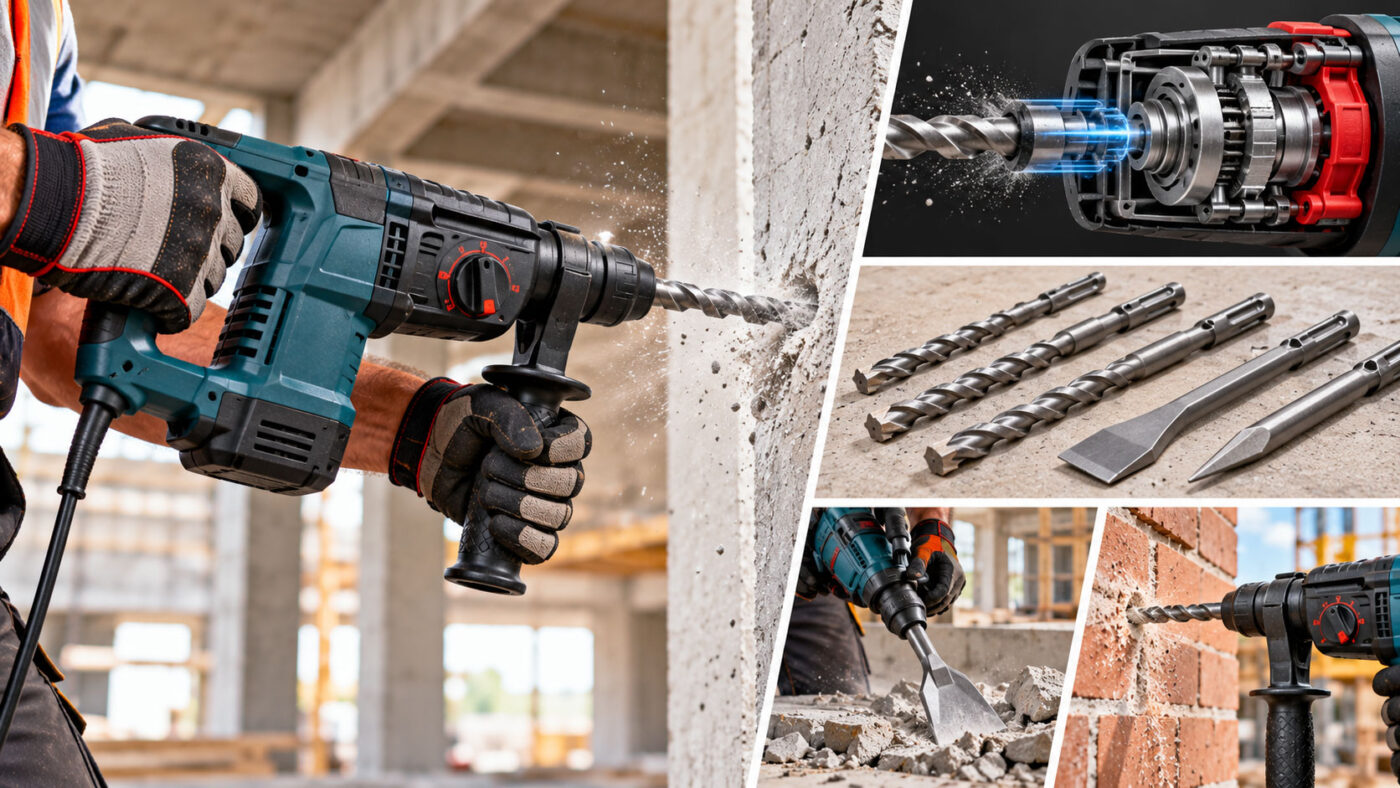
A rotary hammer drill is a heavy-duty power tool that is useful for drilling and chiselling through tough materials like masonry, stone and concrete. Unlike a traditional hammer, the rotary hammer combines rotation with the hammering action to chisel through hard materials.
This guide provides an insight into the mechanism and uses of the rotary hammer.
Mechanism
The rotary hammer drill combines rotating and hammering actions to create an exceptionally powerful tool that can cut through tough materials. The piston mechanism delivers effective hammering blows while the drill bit rotates. Together this creates a pounding action that manages to break down stone, masonry and concrete as required. The motor provides power for both the piston hammer and the drill bit enhancing both power and efficiency. They are often equipped with features such as anti-vibration technology and clutch mechanism to ensure safety and security during their use.
Specialized SDS System
SDS stands for Slotted Drive System, a specially designed chuck and shank mechanism built to withstand the high impact forces produced by these power tools. The SDS uses a slotted chuck to enable quick and easy bit changes without the use of any additional tools.
Modes
The rotary hammer is flexible as it can be operated in three modes. The rotation mode helps it to function like a standard drill for materials such as plastic, metal and wood. The hammer mode minus the rotational action turns the rotary hammer into a small chiselling hammer for demolition tasks. The rotary hammer mode engages both the hammering and rotating actions for high performance drilling through hard materials like concrete or stone.
Uses
It is a versatile power tool and finds a variety of uses in both construction demolition projects. It is widely used for home improvement projects as well as industrial works, favoured by both DIY enthusiasts and professionals. Some of the common uses of the rotary hammer are enumerated below:
1.Drilling
With its rotating action combined with quick hammering it is highly efficient for drilling through hard materials. It is commonly used in construction work for drilling holes for anchor bolts. It can be used to drill for plumbing and electricity works. The drilling action of the rotary hammer is also useful for demolition.
2.Chiselling
In addition to drilling, the rotary hammer can be used for chiselling work. The high impact hammering action allows the user to engage in chiseling actions such as removal of tiles and chipping away at a hard surface like concrete or stone. The selection of the right chisel bit will drive efficiency and allow for clean and precise cuts.
3.Chipping
The rotary hammer is precise as well as powerful. This enables its drill to be used for chipping tasks. It can be efficiently used in removing old paint, rust, or remnants of adhesives. The chipping and chiselling ability of the rotary hammer can be put to good use for creating crafts from hard materials.
As we can see, the rotary hammer is a versatile power tool and an equally valuable asset for every DIY enthusiast and professional for construction and demolition work. Whether it is drilling oversized anchor holes or demolishing concrete slabs and walls, removing tiles or craftwork, the rotary hammer proves to be handy and efficient.

 English