

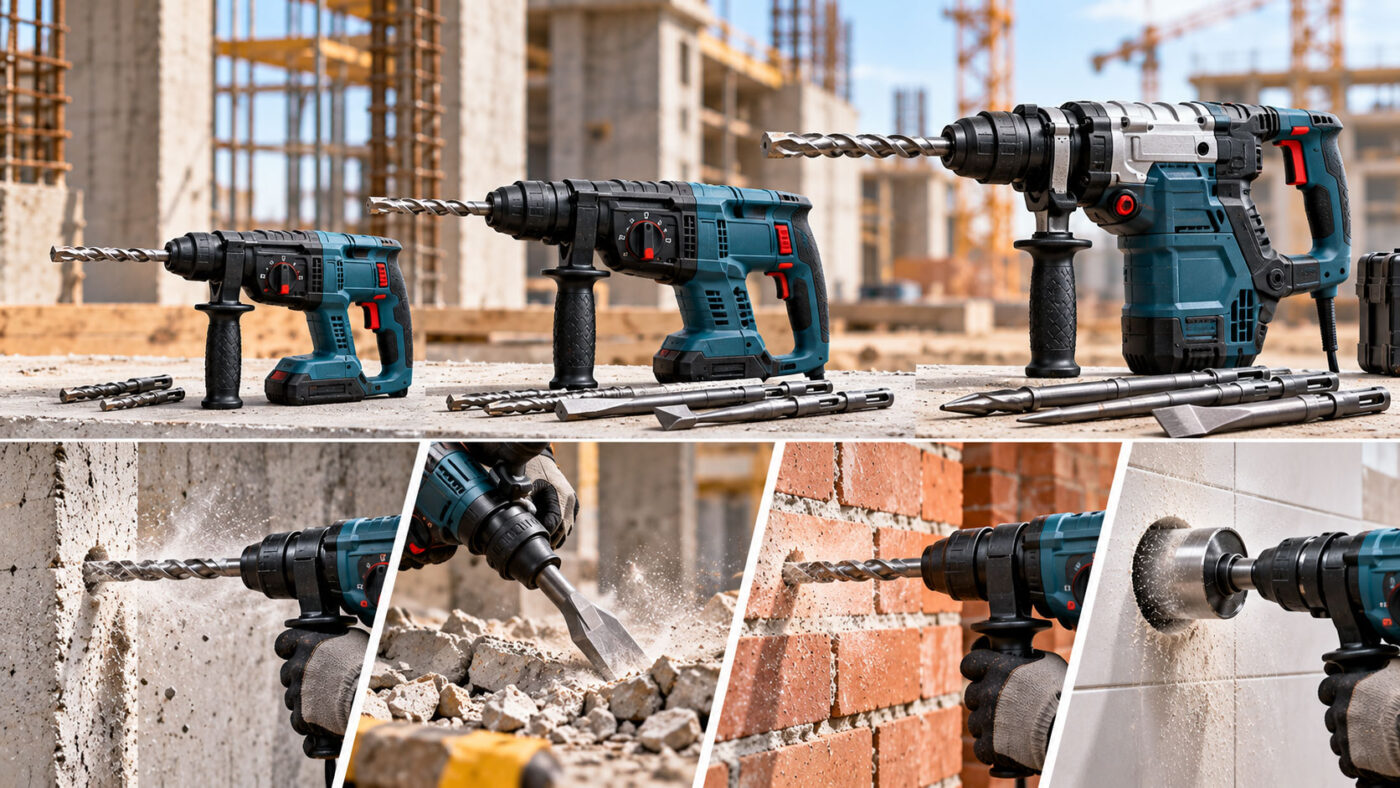
Whether you are drilling holes to mount artwork in your home or doing some heavy work like drilling through concrete masonry, an important tool in your tool kit is the rotary hammer. These power tools combine rotary motion with hammering action to drill through tough materials like concrete and stone.
The choice of this power tool has a direct impact on the efficiency and outcome of the job that needs to be done. Here are some of the factors that need to be considered while choosing the right rotary hammer size for your projects:
Type of project
One of the primary considerations is the size of the hole that needs to be drilled. What is the project that we need the rotary hammer for? If it is a small project like mounting shelves, a half inch rotary hammer would be sufficient. If the project is much larger like drilling through concrete walls then a larger rotary hammer would be needed, say, 1 5/8-inch size.
Corded hammers are also more impactful for larger projects as there is a continuous supply of power. But in tight spaces, they can be quite cumbersome. Cordless rotary hammers, on the other hand, have the advantage of portability and ease of handling.
Power and Weight
If your job involves drilling through hard materials like concrete the rotary hammer you use would need high power output. If being used for lighter materials a lower power output may suffice.
It is important to note that high power output models may also weigh more making it more challenging to work with them. So power and weight have to be considered together while finding the best fit hammer for the job at hand.
Chuck size
Chuck size is an important consideration for any project. A larger chuck size enables drilling tough materials whereas a smaller chuck size is useful when precision is required. Matching the chuck size with the project requirements is important to achieve quality work.
An SDS chuck feature that is provided on many rotary hammers. SDS ( Slotted Drive Shaft or System) allows the bit to move in and out freely while hammering. This makes SDS hammers more suitable for heavy-duty drilling work.
Drilling capacity
The size of the hole rotary hammers create in hard materials is referred to as its drilling capacity. The correct drilling capacity is important for an optimal job.
Drilling capacity of the same rotary hammer will vary depending on the materials to be drilled such as with wood, concrete and steel.
Choosing the right rotary hammers after careful consideration will ensure that the job at hand is completed efficiently and is of high quality. Using different sizes for light to medium tasks such as 1/2 inch drill and maximum power for more demanding projects such as 1- 9/16 inch drill optimizes efficiency for the task at hand.

 English