

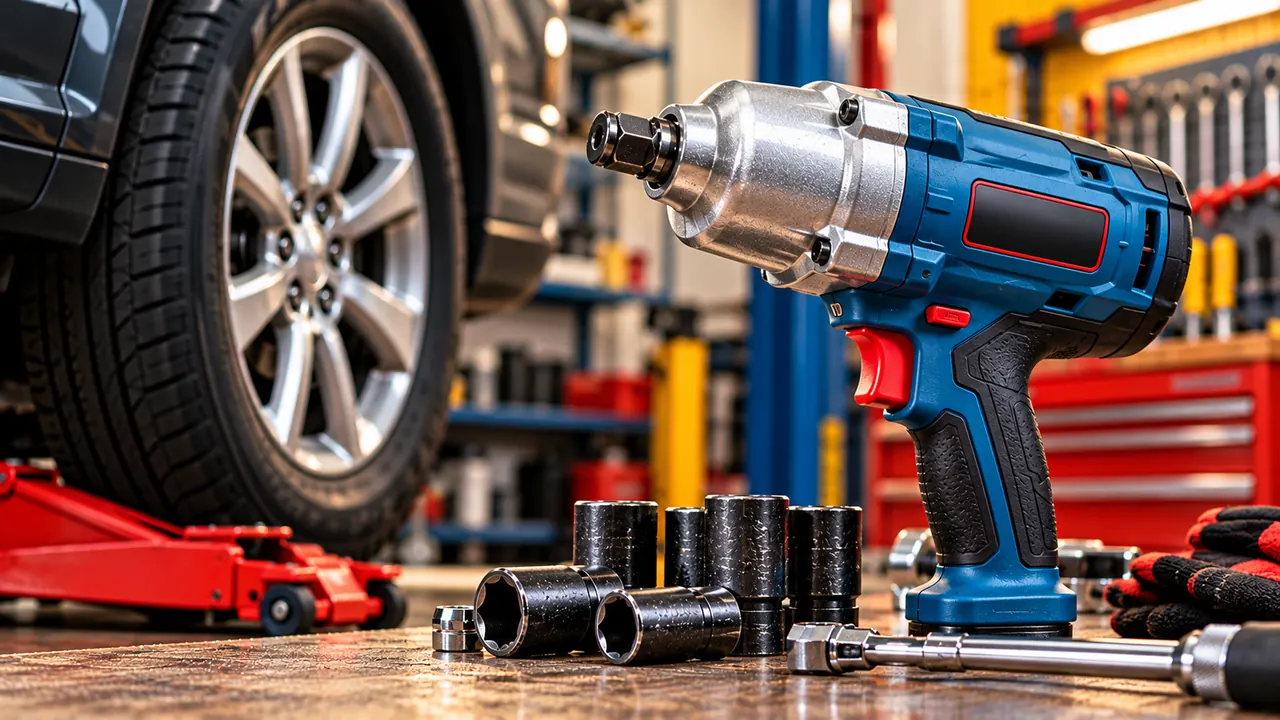
An impact wrench is a high performance power tool that provides greater torque than a regular wrench. This makes it handy for use in assembly of heavy equipment, on construction sites and for automotive repair tasks. While widely seen as garage equipment, an impact wrench is versatile and can be seen at construction sites or being used for furniture assembly with equal ease and efficiency.
Clarke offers a broad selection of impact wrenches, part of a broader catalogue that offers a range of devices such as power tools as well as lifting and garage equipment. In other words, there is an impact wrench available whatever situation you find yourself in. Choosing the right impact wrench becomes vital as it directly impacts how efficiently and effectively a job is done.
Here are a few factors you should consider before making a decision about which impact wrench to buy:
Project type
Primarily, the important question is, what is the impact wrench going to be used for? Is it for household tasks, for use in a garage or for another project? This will affect the choice of the wrench. For light household jobs such as assembling furniture, tightening small fittings, or the occasional DIY fix, a compact corded model will be suitable. On the other hand, If your work tends toward garage jobs including swapping wheels or freeing suspension bolts, you will need more torque but also a cordless design for convenience in narrow spaces.
Power and torque
Torque output is what drives the performance of the impact wrench. It has to be matched to the task at hand. A range of 250 Nm to 300 Nm is generally sufficient for light household jobs but for automotive repairs 500 Nm and above may support work on high strength bolts better.
Higher torque models of an impact wrench will be less compact than lower torque models. This is important to remember if a lot of work needs to be done overhead or in cramped spaces.
Drive size
The ability of the impact wrench to withstand stress depends on the drive size. For routine tasks on the car or any household job an ½ inch drive is generally considered standard. On the other hand if the work involves heavy vehicles or industrial-grade lifting and garage equipment, the torque loads would be higher. A ¾ inch drive will be more appropriate for any heavy, industrial work.
Corded vs. cordless
Corded impact wrenches deliver a continuous, uninterrupted power supply as they are connected to a power source. This makes them suitable when the work involves use for longer durations. The power cord however can cause safety concerns as it may get tangled or frayed. This is especially true when working in confined spaces such as a crowded garage.
On the other hand, cordless models of this power tool offer more mobility. As they are not tethered to a power source, it is easy to move around in a small garage or even a vehicle.
No-load speed and impact frequency
The two factors that govern the efficiency of the tool are no-load speed and impact frequency.
The no-load speed, measured in RPM governs how quickly the wrench spins a fastener before impact starts. The impact frequency measured in blows per minute determines how rapidly those hammering bursts are delivered to overcome resistance. The relationship between the two is important as it helps understand the characteristics of the impact wrench that will need to be used.
For sporadic household tasks, a small corded version of this power tool works best, whereas for demanding garage and automotive jobs, a cordless impact wrench in the 550Nm to 300Nm range, chosen to suit the drive size and bolt strength you typically handle.
The correct choice of impact wrench will depend on all these factors. Making the right choice after deliberation will help complete the task with minimum stress on both the powertool and the user.

 English